Category: Africa

  • What South Africa’s June 30 Deadline Reveals About State Authority and African Integration

    What South Africa’s June 30 Deadline Reveals About State Authority and African Integration

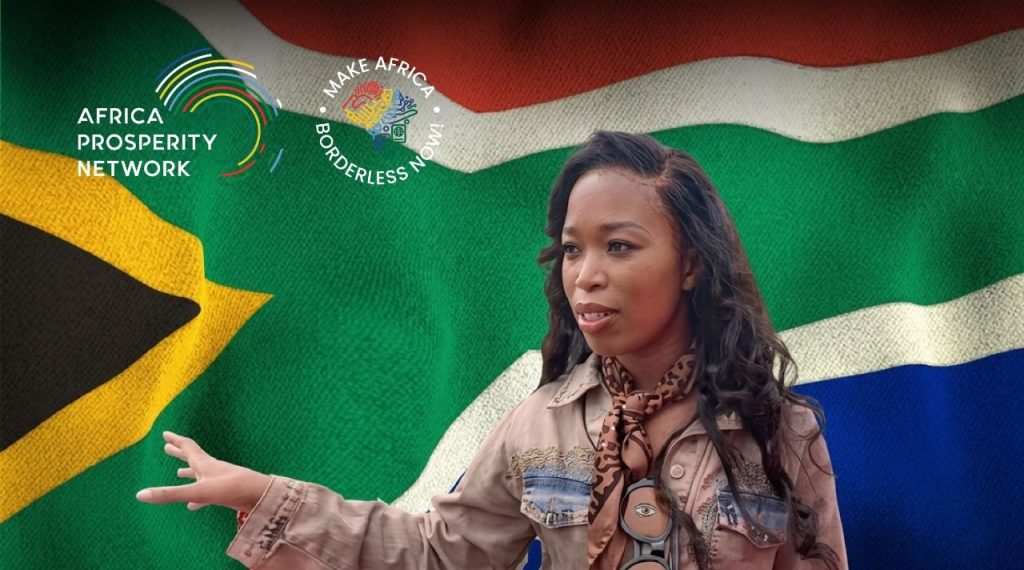
    The events surrounding South Africa’s self-imposed June 30 deadline for undocumented foreign nationals to leave the country may come to be remembered as one of the most extraordinary chapters of governance in post-apartheid Africa. Yet they should also jolt us towards greater solidarity and unity, and inject fresh urgency into Africa’s integration agenda.

    Africa has witnessed mass expulsions before. Ghana’s Alien Compliance Order of 1969 forced hundreds of thousands of West Africans, mostly Nigerians, to leave. Uganda under Idi Amin expelled its Asian population in 1972. Nigeria’s “Ghana Must Go” exercise of 1983 led to the repatriation of well over a million migrants, mostly Ghanaians. These episodes were regrettable, traumatic and, in some cases, catastrophic. But they had one thing in common: they were state-driven policies, executed by governments exercising sovereign authority, however myopically.

    What makes South Africa’s June 30 moment different, and perhaps more disturbing, is that the state itself was not leading events. It was reacting to them.

    Citizen movements, social media personalities and self-appointed activists, many dressed in symbolic regalia and broadcasting their activities in real time, succeeded in shaping the national conversation on immigration in a way that few could have anticipated. As their videos attracted millions of views on TikTok, Instagram and other platforms, and as vloggers followed their every move, their influence and visibility grew significantly. This raises difficult questions for any constitutional democracy about the balance between legitimate civic activism, social media mobilisation, and the responsibility of the state to maintain public order and ensure that matters of immigration policy remain firmly within the framework of the rule of law.

    More troubling still was the perception that the authorities initially stood by, allowing intimidation, harassment and public vigilantism to flourish without decisive intervention. Predictably, this emboldened those involved. For when a state hesitates to exercise its authority, others inevitably step forward to fill the vacuum.

    Continental Outlier

    This is why many analysts argue that what we are witnessing is not simply a migration crisis. What the rest of Africa appears to be seeing is the visible manifestation of a state losing control over the narrative, over the streets and, ultimately, over its own legitimacy to influence the continent’s all-important policy direction on economic integration and related matters. Sadly, South Africa is today at risk of becoming a continental outlier on African solidarity; a nation whose moral authority in Africa is being seriously damaged by these events.

    South Africa’s coalition staggers on while confidence, both domestic and international, steadily erodes. The government of President Cyril Ramaphosa has suffered a serious blow to its credibility and has its work cut out to restore it. If it cannot be seen to guarantee the safety and dignity of all those living within its borders, including fellow Africans, then institutions such as the African Union must be prepared to speak and act with greater moral clarity.

    Free Movement of Persons

    But Africa must also have the courage to confront the deeper truth behind this crisis. We are here because African leaders have collectively faltered in implementing one of the continent’s most ambitious political projects: the Treaty Establishing the African Economic Community, adopted in Abuja in 1991, which envisioned a progressively integrated Africa with free movement, a customs union, a common market and, ultimately, an African Economic Community. The subsequent Protocol to the Treaty Establishing the African Economic Community Relating to Free Movement of Persons, Right of Residence and Right of Establishment, adopted in Addis Ababa in 2018, was intended to make that vision a reality. Yet eight years later, only four countries have ratified it. Africa’s leaders embraced the rhetoric of integration while retreating from its practical implementation. What is unfolding in South Africa is, in part, the consequence of insufficient action on integration.

    The great irony is that South Africa, whose domestic politics often betray a degree of scepticism towards deeper African integration, is precisely the country that stands to gain most from it. Africa’s single market of 1.5 billion people offers unparalleled opportunities for economies with advanced manufacturing, services and logistics sectors. The prosperity of South Africa lies not in turning inward, but in embracing the rest of Africa more warmly.

    As many analysts have observed, the Afrophobia visible in South Africa today is less about foreigners than about a disappointment that may not be peculiar to that country. Millions of South Africans feel betrayed by a political and economic system that has failed to deliver security, prosperity and dignity. But rather than confront the structural causes of that failure, some activists have chosen a weaker and more vulnerable target: black Africans from elsewhere on the continent.

    Social psychologists have long recognised this phenomenon. It is the politics of unification through a common enemy: the creation or exaggeration of an external threat to divert attention from internal failures. It is scapegoating masquerading as patriotism.

    The way we fight this is to pile greater pressure on our leaders across the African continent to implement the policies and strategies of the AU that will enable the free movement of people, goods, services, capital and creativity across Africa for our shared prosperity and dignity.

    The author is the Founder and Executive Chairman of the Africa Prosperity Network, organisers of the annual Africa Prosperity Dialogues. He is also the Senior Partner of Africa Legal Associates, ALPi Ghana, a Pan-African commercial law firm.

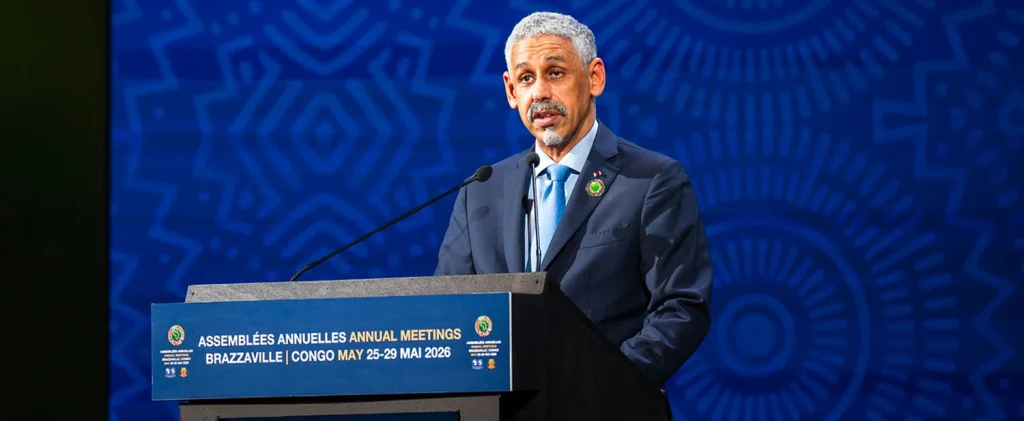
  • Closing Remarks Delivered by Dr Sidi Ould Tah, President of the African Development Bank Group – 2026 Annual Meetings of the African Development Bank Group

    Closing Remarks Delivered by Dr Sidi Ould Tah, President of the African Development Bank Group – 2026 Annual Meetings of the African Development Bank Group


    Africa stands at a decisive turning point in its history. Agenda 2063 charts our course: a united, prosperous, and sovereign Africa. The AfCFTA (Africa Continental Free Trade Area) gives us the macroeconomic instrument to translate that ambition into reality. But it is our bold political decisions that will make the difference on the ground.

    To read more, click here: https://www.afdb.org/en/news-and-events/speeches/closing-remarks-delivered-dr-sidi-ould-tah-president-african-development-bank-group-2026-annual-meetings-african-development-bank-group-93831

  • Press release: Africa Prosperity Network mobilises continental leaders for 2nd Make Africa Borderless Now! webinar, as momentum builds for visa-free Africa

    Press release: Africa Prosperity Network mobilises continental leaders for 2nd Make Africa Borderless Now! webinar, as momentum builds for visa-free Africa

    Accra, Ghana – 24 May 2026 — Momentum toward a visa-free Africa is steadily gaining ground across the continent as more African countries begin taking practical steps to remove barriers to movement, trade, tourism, and continental integration.

    Just last week, Togo became the sixth African country to offer visa-free travel to all Africans and not only ECOWAS citizens, adding fresh impetus to the growing campaign for the free movement of Africans within Africa.

    Coinciding with Africa Union Day 2026, Ghana will officially begin implementing its long-awaited visa-free policy for African citizens from 25 May 2026, fulfilling a commitment first publicly announced during the 2024 Africa Prosperity Dialogues (APD) in Accra. The implementation will also be accompanied by the expected rollout of an electronic visa application system for all other travellers. This is expected to significantly ease travel procedures and boost tourism, connectivity, business travel, and investment into the country.

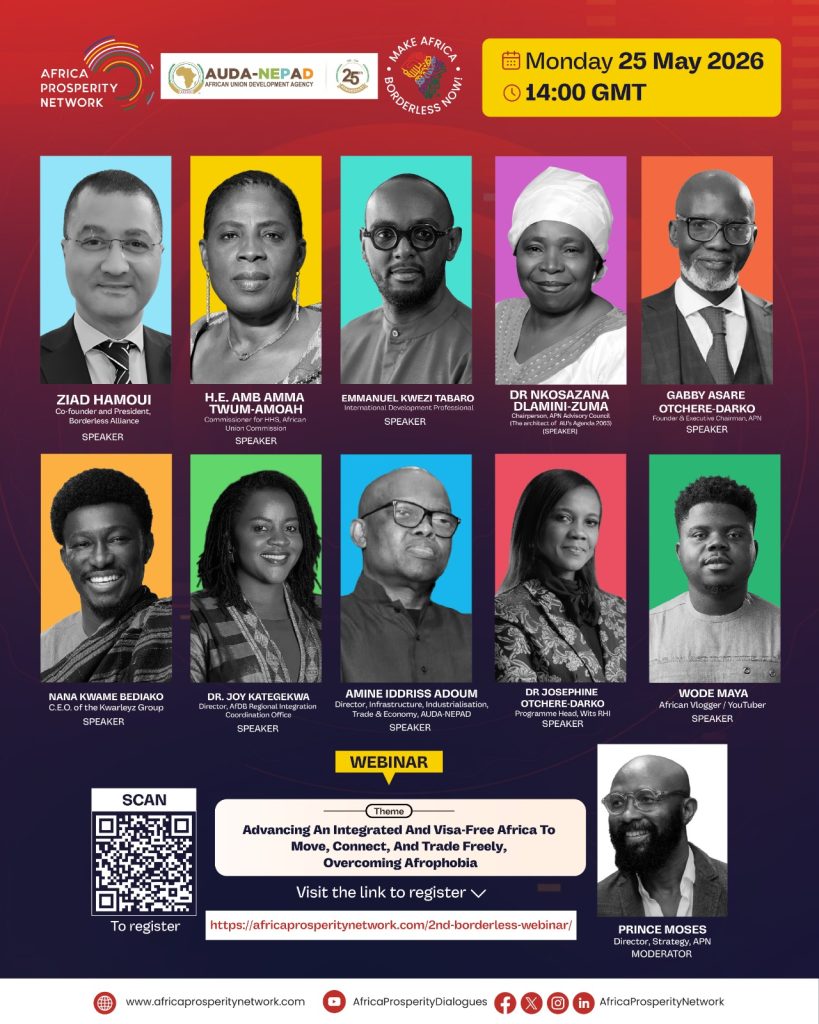
    Against this backdrop, the Africa Prosperity Network (APN) will on Monday host an AU Day Special Webinar. This marks the second edition of its flagship Make Africa Borderless Now! (MABN) webinar, bringing together policymakers, development institutions, business leaders, academics, civil society actors, youth advocates, and Pan-African voices to advance practical solutions for continental free movement and economic integration.

    The webinar forms part of APN’s broader continental advocacy campaign aimed at accelerating implementation of the African Union Protocol on Free Movement of Persons, Right of Residence and Right of Establishment, alongside other integration instruments necessary for the success of the African Continental Free Trade Area (AfCFTA).

    The webinar will also examine the economic and social consequences of “Afrophobia” and restrictive migration systems, while exploring how freer movement can strengthen tourism, entrepreneurship, skills mobility, investment, and intra-African trade.

    While the Free Movement protocol was adopted in 2018, progress toward its implementation has remained slow, with only four ratifications to date.

    APN and its partners have consistently argued that Africa cannot fully realise the promise of the AfCFTA while Africans themselves continue to face restrictions moving across their own continent.

    “The advocacy for a borderless Africa is beginning to gain real traction,” said Gabby Asare Otchere-Darko, Founder and Executive Chairman of the Africa Prosperity Network. “We are encouraged that more African countries are beginning to recognise that the free movement of Africans is an economic necessity. Ghana’s long-awaited implementation of its visa-free policy and Togo’s recent decision demonstrate that progress is possible when leadership aligns with continental vision.”

    He added: “Africa cannot build a genuine single market while Africans remain strangers to one another at the borders of their own continent.

    “The implementation of visa-free policies, digital travel systems, interoperable payment platforms and open skies are practical steps toward unlocking Africa’s economic potential,” the APN founder said.

    To be held Monday at 14:00 GMT, the webinar is expected to attract a large global audience, who will be free to ask questions and make contributions. 

    Speakers will include, H.E. Amma Twum-Amoah, Commissioner for the African Union Department of Health, Humanitarian Affairs and Social Development, H.E. Dr Nkosazana Dlamini-Zuma, former Chairperson of the AU and architect of AU’s Agenda 2063. There will presentations from Amine Iddriss Adoum, Director, Infrastructure, Industrialisation, Trade and Economy, AUDA-NEPAD and Dr. Joy Kategekwa, Director of the African Development Bank Regional Integration Coordination Office.

    Other speakers include Ziad Hamoui, Co-Founder and President of Borderless Alliance; Emmanuel Kwezi Tabaro, Energy Policy Researcher and International Development Professional from Uganda; Nana Kwame Bediako, CEO of Kwarleyz Group; Wode Maya, African YouTuber and vlogger; and Prince Moses, Director of Strategy at APN, who will moderate the discussions.

    We will also hear from two professional migrants from Ghana and Cameroon domiciled in South Africa about their experiences.

    According to the Africa Visa Openness Index, Africans still require visas to travel to nearly 45 percent of African countries, despite decades of Pan-African commitments toward integration. APN maintains that removing these barriers is central to empowering SMEs, women, and young entrepreneurs under the AfCFTA framework.

    The Make Africa Borderless Now! campaign, launched during the 2026 Africa Prosperity Dialogues in Accra, is mobilising signatures to support the implementation of AU treaties and protocols related to free movement, digital trade, cross-border payments, and continental integration. Signatures gathered through the campaign will be presented to African Union leaders during the 40th Ordinary Session of the Assembly of the African Union in Addis Ababa in February 2027.

    To register for the webinar, visit:

    To support or sign the movement’s petition, visit: www.makeafricaborderlessnow.com

    About Africa Prosperity Network

    The Africa Prosperity Network is a not-for-profit organisation dedicated to mobilising Africa’s private sector and policy leaders to advance economic integration, prosperity, and the implementation of the African Continental Free Trade Area. Its flagship initiative, the Africa Prosperity Dialogues, convenes leaders annually to accelerate practical collaboration toward a single African market.

    About Make Africa Borderless Now!

    Make Africa Borderless Now! is a continental movement advocating the free movement of Africans, the removal of barriers to trade and mobility, and the implementation of African Union integration commitments.

    END

    For Media Enquiries:

    Prince Moses

    Director, Strategy | Africa Prosperity Network

    Email: princemoses@africaprosperity.network

    Joel Krampa

    Communication Lead | Africa Prosperity Network

    Email: j.krampa@africaproserity.network

    APN Communication Directorate

    Email: comms@africaprosperity.network

    Website:  Africa Prosperity Network

    #MABN!

    Distributed to all African and International media houses

  • Press release: Africa Prosperity Network applauds Togo’s historic visa-free decision

    Press release: Africa Prosperity Network applauds Togo’s historic visa-free decision

    Togo Becomes Sixth Nation to Embrace Borderless Africa; Fulfils Vision Articulated at APD 2025

    Accra, Ghana – 20 May 2026 – The Africa Prosperity Network (APN) has welcomed the Republic of Togo’s historic announcement to grant visa-free entry to all African citizens, effective 18 May 2026. The decision, allowing 30-day visa-free access for holders of valid African passports, represents a powerful affirmation of the ‘Make Africa Borderless Now’ campaign and demonstrates that continental integration is becoming a top priority of governments in Africa.

    From Vision to Action: President Gnassingbé’s Commitment

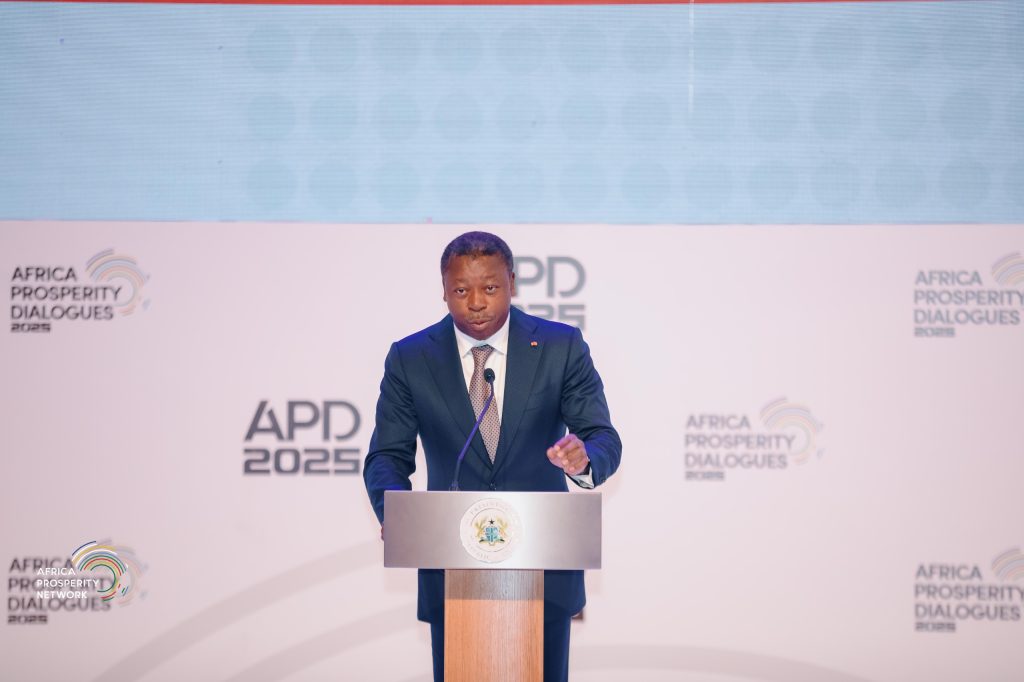
    President Faure Gnassingbé’s decision builds on a vision he articulated at the Africa Prosperity Dialogues (APD) 2025, where he stated that his country’s commitment to Africa’s single market is a powerful enabler for empowering SMEs, women and youth entrepreneurs. Today’s announcement moves that vision further into concrete policy, enabling greater mobility and trade across the continent, beyond the ECOWAS region.

    “Togo’s decision validates the momentum of the ‘Make Africa Borderless Now’ movement,” said Gabby Asare Otchere-Darko, Founder and Executive Chairman, APN. “As six African nations now lead in embracing visa-free travel, they send a clear message: integration is fast-moving beyond aspiration into an urgent imperative that today’s leaders are embracing with courage.”

    We also commend the AfCFTA Secretariat for its efforts in championing the single market agenda.

    Six Nations Leading the Way

    With Togo’s announcement, six African nations have now formally committed to visa-free access for African citizens:

    Rwanda, Benin, The Gambia, Seychelles, Togo and Ghana. Ghana is preparing to rollout her visa-free policy on 25 May 2026.

    Progress, however, remains insufficient. The African Development Bank’s Visa Openness Index (AVOI) reveals that only 28.2% of intra-African travel routes are currently visa-free. Only four countries have so far ratified the African Union’s Free Movement Protocol, which was adopted in 2018; far short of the fifteen required for implementation. This represents a critical barrier to the African Continental Free Trade Area (AfCFTA) and the continental prosperity agenda.

    The Case for Borderless Africa

    The African Development Bank estimates that increased intra-African migration could boost each country’s GDP by approximately one per cent, a figure that, across 54 nations, would be transformative. Yet visa restrictions, rooted in fear, continue to fragment the continent. Free movement is essential to unlocking continental prosperity, enabling African entrepreneurs, traders, and citizens to move, work, and invest across borders without barriers.

    The Africa Prosperity Network calls upon all remaining African nations to follow Togo’s example. We urge the African Union to accelerate ratification of the Free Movement Protocol and mobilise all member states toward comprehensive visa-free policies.

    Join the Conversation: AU Day Webinar, 25 May 2026

    APN will host a strategic webinar on Africa Union Day, 25 May 2026, at 14:00 GMT under the theme ‘Confronting Afrophobia Through Economic Integration: Advancing a Visa-Free Africa for Africans to Move, Connect and Trade Freely.’

    The webinar will bring together African policymakers, civil society leaders, and business executives to accelerate the shift toward open borders, generate policy commitments, and mobilise signatures for presentation to AU leadership in February 2027.

    To register to attend the webinar, visit: https://africaprosperitynetwork.com/2nd-borderless-webinar/

    To donate or add your signature to support the movement, visit: www.makeafricaborderlessnow.com

    About Africa Prosperity Network: Africa Prosperity Network is a not-for-profit organisation registered under the laws of the Republic of Ghana. APN provides a platform for leaders, particularly in business and politics across Africa, to collaborate to achieve sustainable prosperity across the continent. The organisation’s flagship initiative, the Africa Prosperity Dialogues, serves as an annual forum for continental decision-makers to address critical economic development challenges and opportunities.

    About Make Africa Borderless Now! Movement: Make Africa Borderless Now! is a pan-African movement dedicated to accelerating the free movement of people, goods, and capital across Africa, and to holding governments and institutions accountable to the continent’s integration commitments.

    END

    For media inquiries, please contact:

    Prince Moses, Director, Strategy | Africa Prosperity Network| E- mail: princemoses@africaprosperity.network | Accra. Ghana

    Joel Krampa, Communication Lead | Africa Prosperity Network | E-mail: j.krampa@africaproserity.network | Accra. Ghana

    APN Communication Directorate: comms@africaprosperity.network  

    Website: www.africaprosperitynetwork.com

     Follow us: Facebook, X(Twitter), LinkedIn, YouTube, WhatsApp, TikTok

    #MABN!

    Distributed to all African and International media houses

  • We are not capital-poor; we are market-shallow and system-broken

    We are not capital-poor; we are market-shallow and system-broken

    By Amine IDRISS ADOUM,  Director of Economy, Infrastructure, Industrialisation, Trade and Regional Integration, AUDA-NEPAD

    Make Africa Borderless Now! must echo through AU Summits, Regional Economic Community (REC) ministerials, central bank committees, capital-market regulators’ meetings, investor forums, and every global platform where our continent’s future is debated—from Davos to the G20 to the UN General Assembly. Because what holds us back is not a shortage of priorities. It is a broken operating system: we still finance Africa like a fragmented consumer market, not like an integrated continent of producers.

    For years, we have repeated the phrase “financing gap” as if it were a diagnosis. It is often a distraction. When we aggregate our pensions, insurance assets, sovereign wealth funds, banking pools and other public savings vehicles, we are already sitting on well over 2 trillion USD in domestic capital—before we even count diaspora resources or the vast savings and investment cycles in the informal economy. So the real question is not “where is the money?” The real question is: why can’t our money find our factories?

    The answer is uncomfortable—but liberating: our money is not missing; it is trapped. It is parked in short-term government securities and deposits not because our asset managers lack patriotism, but because our markets lack depth. We have underbuilt the mechanisms that convert savings into investment: long-tenor instruments, credible local-currency yield curves, liquid bond markets, bankable project pipelines, credit enhancement, predictable settlement systems, and crucially—a regional investment space where capital can diversify and scale. In other words, we are not capital-poor; we are market-shallow and intermediation-poor. We have the fuel, but we have not built a powerful enough engine—and we have not connected it across borders.

    That is why Africa’s most urgent reform agenda is not another declaration. It is financial depth. We need capital markets that can price risk properly, mobilise long-term savings, and finance industry. We need central banks and regulators to move from “guardians of stability” to “architects of depth”: modernise payment and settlement rails, build benchmark yield curves, enable long-tenor local-currency instruments, strengthen collateral and insolvency frameworks, and harmonise rules across regions so investors can scale beyond national silos. Without these reforms, our institutional capital will continue to behave rationally and unproductively—because there will be no safe, investable route into productive assets. And without cross-border interoperability, domestic financing will remain too small, too expensive, and too short-term to industrialise a continent.

    Borderless Africa is not poetry

    This is also why we must stop treating “borderless Africa” as poetry. Borderless Africa is the financing strategy. Capital cannot power industrial corridors if it is fenced in by regulatory islands. AfCFTA will not deliver if it remains a legal framework without an integrated investment space. Trade must become predictable so cashflows become bankable; payments must become interoperable so commerce becomes scalable; and markets must become connected so savings can move into production. A continent of makers cannot be built on 50-plus disconnected financial systems.

    Here is the good news: the African development and financing community is already shifting from talk to mechanisms. The African Union Development Agency-New Partnership for Africa’s Development (AUDA-NEPAD), Afreximbank, African Development Bank (AfDB), regional development banks, Africa50, Africa Finance Corporation (AFC), national development banks and other African Development Finance Institutions (DFIs)—working through cooperation platforms such as the Alliance of African Multilateral Financial Institutions (AAMFI, also known as the “Africa Club”) —are building the enabling architecture that turns priorities into investable assets. 

    The Luanda Financing Summit offered a clear signal: we can move from speeches about “gaps” to building balance-sheet solutions. Through AAMFI, we launched a dedicated infrastructure financing facility anchored by an initial 1.5 billion USD commitment—an African leverage platform designed to de-risk and crowd in much larger pools of domestic institutional capital. But AAMFI is not the story by itself; it is the coordination layer. The scale comes when our DFIs act as a system: aligning pipelines, co-financing, guarantees, project preparation and risk tools to create assets that African pension funds and insurers can buy—at the right tenor, in the right currency, with risk structured professionally.

    Finance, however, needs destinations. That is why our continental platforms matter. The Programme for Infrastructure Development in Africa – Priority Action Plan 2 (PIDA-PAP2) is not “a list of roads”—it is the physical internet of the African Continental Free Trade Area (AfCFTA): corridors, ports, rail, digital backbones, and border efficiency that make trade real. The Continental Power Systems Master Plan is the other half: we cannot industrialise in the dark. A borderless energy market—where power can be generated where it is cheapest and traded where it is needed—is how we lower production costs and make African manufacturing competitive. And if infrastructure is the hardware, PAIDA is the software: a deliberate push to build regional value chains, industrial clusters and processing capacity so we stop exporting jobs and importing finished goods.

    Tariffs and Compliance

    But there is a silent killer that keeps undermining our market-access promises: quality infrastructure. We often say we did not fully exploit the African Growth and Opportunity Act (AGOA) because we lacked competitiveness. The deeper truth is technical: we lacked the standards, labs, accreditation, certification, metrology and market surveillance to meet demanding requirements consistently and at scale. Tariffs were never the only barrier; compliance was. If we do not invest in quality infrastructure and harmonise standards across regions, AfCFTA will also underdeliver—because non-tariff barriers will replace tariffs as the real wall. A maker continent is built on trust, and trust is built on standards.

    We should also confront the largest balance sheet we keep ignoring: the informal economy. We treat it as a governance problem when it is also a capital-formation opportunity. Millions of Africans save, trade, lend and reinvest daily outside formal channels. The goal is not to harass them into paperwork; it is to build pathways—digital payments, identity, credit histories, simple investment vehicles, interoperable settlement—that make cashflows legible and investable. Deep capital markets do not only mobilise pensions and insurers; they can also unlock informal savings and enterprise growth by connecting everyday commerce to formal finance.

    So here is the proposition we should carry from APD 2026 to every AU Summit and every global forum: we will not industrialise by chasing external money while our own capital stays idle. We will industrialise when we complete the reforms that create financial depth and when we finish building a borderless financial machine that connects our savings to productive assets. That machine is not abstract: it is being built by the African development and financing community—AUDA-NEPAD, Afreximbank, AfDB, regional development banks and other African DFIs—coordinating through AAMFI and allied platforms; powered by continental pipelines such as PIDA-PAP2 and the Continental Power Systems Master Plan; guided by PAIDA in a truly borderless AfCFTA market; and anchored by a unified quality infrastructure ecosystem that makes “Made in Africa” competitive and tradable.

    We already have entrepreneurs. We already have demand. We certainly have capital. What we need urgently is the discipline to build depth, integrate markets, and complete the architecture that turns our money into factories. That is how we stop being described as a consumer continent and finally become what we already claim to be: a continent of makers.

  • Ubuntu, Afrophobia and Africa’s Unfinished Struggle for Unity

    Ubuntu, Afrophobia and Africa’s Unfinished Struggle for Unity

    By Gabby Asare Otchere-Darko

    This month, the news about Africa continues to centre around the disturbing images from South Africa circulating worldwide on social media. Not even the Africa Forward Summit in Nairobi could shift that. African migrants were attacked, their shops looted, people chased, assaulted and blamed simply for being from another African country and seeking to make a living in South Africa. Incidentally, many of the people victimised claimed to have the right of residence in the country.

    It is painful. It is shameful. And, frankly, it can turn many of us into incurable pessimists over the all-important task in front of us this century: the economic integration of Africa.

    But if we are honest with ourselves, this is not merely a South African problem. Today, several African countries, including Ghana, have laws that prohibit other Africans (foreigners in general) from participating in some level of the retail market.

    In the past, Ghana deported Nigerians under the Aliens Compliance Order in 1969. Nigeria retaliated years later with the infamous “Ghana Must Go” expulsions of the early 1980s. Across the continent, at different moments of economic stress, Africans have turned against fellow Africans.

    This tells us something uncomfortable: xenophobia in Africa is not simply about economics or migration. It is, indeed, an existential psychological baggage. A colonial hangover. A lingering “divide and rule” mentality that we inherited but have still not found the courage to fully confront. It is what has been described as “Afrophobia.”

    Afrophobia is the fear, hostility, prejudice, discrimination or hatred directed by Africans against fellow Africans from other African countries. Unlike classical xenophobia, which broadly targets foreigners, Afrophobia describes a uniquely African contradiction: Black Africans treating other Black Africans as outsiders, threats or lesser people within Africa itself.

    Afrophobia is a crisis of African consciousness and identity. It is especially tragic because Africa’s liberation struggles were fought and won on Pan-African solidarity. A continent that 60 years ago preached unity and shared destiny, and today, gingerly seeking to implement its own treaties and protocols for integration, has to do so under a blinding cloud of Afrophobia. This is a betrayal of the Pan-African ideal and a stark reminder that we may still be victims of the old colonial construct, subconsciously, to the detriment of our own destiny.

    Colonial borders did not merely divide territories. They divided consciousness. They conditioned Africans to see each other not as partners in a shared civilisation, but as competitors for survival within artificial nation-states.

    However, history tells us that African civilisation itself was built on movement. Let us use the SADC zone as an example. Long before colonial borders existed, Africans moved freely across what is now Southern Africa. Communities traded, intermarried, and migrated for grazing, commerce and opportunity. Identities were shaped more by culture and kinship and not by passports or national flags.

    Ironically, South Africa itself became what it is today partly because it attracted migrants and fortune seekers. The discovery of diamonds in 1867 and gold in 1886 transformed South Africa into an economic magnet. Europeans flocked there seeking prosperity. Colonial mining systems then recruited labour from across Southern Africa, mainly Mozambique, Lesotho, Malawi, Zimbabwe and beyond. Migrant labour built the mines, the railways and much of the economy itself.

    Under apartheid, that labour system became more brutal and exploitative. Black South Africans suffered under pass laws and segregation, while African migrants were treated as disposable labour. Yet even during that dark period, regional migration continued because economies are ultimately built by human movement, labour and exchange.

    My own father, the late Dr JF Otchere-Darko, a surgeon, moved to South Africa in the 1980s to heal people and teach medical students. At that time, the rest of Africa stood firmly with South Africa. African countries, like Ghana, hosted exiles. Liberation fighters were trained across the continent. Zambia, Tanzania and many others absorbed political and economic costs for supporting the anti-apartheid struggle. African states funded solidarity campaigns, endured destabilisation raids and sacrificed economically for South Africa’s freedom.

    That history matters, which is why xenophobia against Africans in democratic South Africa feels, to many Africans, like a historical betrayal.

    To be fair, the frustrations inside South Africa are real. Unemployment is painfully high. Inequality remains among the worst in the world. Crime, weak policing and poor service delivery have left many communities frustrated and vulnerable.

    But the Nigerian trader, the Ghanaian doctor, the Zimbabwean teacher, the Somali shopkeeper, the Ethiopian entrepreneur, the Congolese student or the Mozambican worker did not create those structural failures. Black migrants have too often become the easiest scapegoats for much deeper economic and governance problems.

    Ironically, South Africa itself has been one of the greatest architects of African integration and economically stands today to be one of the biggest beneficiaries of an integrated, single African market because of the country’s relatively advanced industrial capacity.

    The African Union itself was operationalised in Durban in 2002 when the Organisation of African Unity transitioned into the AU. Under President Thabo Mbeki, South Africa became a leading driver of the African Renaissance and institutional Pan-Africanism.

    Notably, South Africa helped shape NEPAD, the African Peer Review Mechanism (APRM), the Pan-African Parliament hosted in Midrand, Agenda 2063 (the blueprint for Africa’s future) and the implementation push for the AfCFTA.

    Under Dr Nkosazana Dlamini-Zuma, the AU deepened its long-term integration agenda through Agenda 2063: a blueprint for free movement, infrastructure integration and a continental single market. Today, as the Chairperson of Africa Prosperity Network, she continues to push for the single market as a more assured form of achieving economic transformation and shared prosperity, security and integrity for Africa, Africans and people of African descent everywhere.

    Even today, South Africa’s own economic future depends heavily on Africa’s integration. Indeed, one of the central arguments for deeper African integration is that South African companies have already demonstrated that African markets are commercially viable at scale. Their expansion across the continent has effectively made South Africa one of the most economically interconnected countries in Africa.

    Its banks, telecoms companies, retailers, mining houses and industrial firms are among the most pan-Africanised corporations on the continent. South Africa needs open African markets as much as Africa needs South Africa. MTN Group, Shoprite Holdings, Standard Bank Group, Absa Group, MultiChoice Group, Naspers, Vodacom, Bidvest Group, Pick’n Pay, Sasol, Old Mutual, etc., are household names across Africa, making billions of dollars and paying taxes in billions of rand in South Africa for the benefit of the people there.   

    Which is why the contradiction is becoming increasingly difficult to ignore. South Africa cannot be both the engineer and the winner of African integration at the continental level while hesitating about it at the national level.

    The legacy of Nelson Mandela, the institutional vision of Thabo Mbeki and the continental architecture advanced by Nkosazana Dlamini-Zuma all point in one direction: Africa must integrate in practice.

    It is why we, at the Africa Prosperity Network, have made the advocacy for the implementation of Africa’s single market agenda our main goal. If Africa is to progress, then we must leverage on our high numbers, 1.5 billion and rising, our rich natural resources, our diversity and shared challenges and opportunities to build an awesome single market.

    This is also where Ubuntu becomes important. Ubuntu is one of Africa’s greatest philosophical gifts to humanity. In its simplest form, Ubuntu means: “I am because we are.” But at its deepest, Ubuntu is a moral framework about human interconnectedness. It teaches that our humanity is tied to the humanity of others.

    Indeed, at the Africa Prosperity Network and through the Make Africa Borderless Now! campaign, Ubuntu is foundational to how we think about Africa’s future. We believe Africa’s prosperity will come not from fragmentation, but from unity. Not from fear of one another, but from scale, mobility, collaboration and integration.

    Xenophobia, therefore, is not only an attack on African migrants in Africa; it is an attack on Africa’s spiritual grounding for her future of fulfilment and collective success, Ubuntu itself.

    When President Cyril Ramaphosa declared in his 2026 State of the Nation Address that “South Africa belongs to all who live in it,” he echoed the spirit of Ubuntu itself. But Ubuntu is not just about talk. The leadership of South Africa has been, frankly, evidently spineless in tackling head-on this issue that hits at the very core of Africa’s future.

    Ubuntu cannot survive merely as rhetoric. It must be defended through policy, policing, political leadership and public education. Xenophobic attacks against Africans must be treated for what they are: hate crimes.

    Communities must be engaged more deliberately. Political rhetoric that normalises suspicion against “foreign Africans” must stop. Migration systems must become smarter, more efficient, and those who break the laws of the land must be dealt with accordingly.

    And, importantly, Africans themselves must stop confusing borderless integration with lawlessness. A borderless Africa does not mean that people can do as they please. West Africa, since the ECOWAS treaty on free movement was adopted in 1979, allows free movement of people, goods and services, but the region is not experiencing any unusual flow of, say, Ghanaians to Nigeria or vice-versa as we saw in the 1960s and 70s.

    A borderless Africa does not mean uncontrolled chaos. It means smarter borders using biometric identity systems, shared intelligence, mutual recognition of skills, interoperable digital payments, fair labour standards and easier legal movement for trade, work and entrepreneurship.

    The future is already clear. From the Abuja Treaty of 1991 to the AfCFTA Agreement of 2018 and the AfCFTA Digital Trade Protocol of 2024, Africa has already committed itself to deeper integration. So the issue now is implementation. The loudest way we can, therefore, establish our protest against the culture of Afrophobia is to accelerate the pace of greater economic integration.

    Perhaps, nowhere is this conversation more urgent than now. As Africa marks AU Day 2026, we must ask ourselves difficult questions: Will Africa succumb to fear or commit to fraternity? Will we continue treating fellow Africans as outsiders inside Africa?

    Or, will we finally build the borderless continent our founders envisioned? Kwame Nkrumah warned more than 60 years ago: “Let us now, fellow Africans, add to our resolve the specific task of creating a United States of Africa, enabling us to maintain a mastery of our own destiny.”

    That unfinished conversation now returns, and with renewed urgency.

    The Africa Prosperity Network will be hosting a special webinar on AU Day. Join APN and the Make Africa Borderless Now! campaign and express your views on our AU Day Special Webinar:

    “Afrophobia or a Borderless Africa? Advancing African Unity Through Economic Integration”

    Monday, 25 May 2026 14:00 GMT

    As xenophobia rises across parts of the continent, this conversation has never been more necessary. A prosperous South Africa needs a prosperous Africa. A prosperous Africa needs Africans to remember one thing above all, which is that before colonial borders divided us, we already belonged to one another, and before we can truly be free, we must go together.

    The author is the Founder and Executive Chairman of the Africa Prosperity Network. He is also the Senior Partner of Africa Legal Associates (ALPi Ghana), part of the Africa Law Practice International Group. He can be reached at gabby@africaprosperity.network

  • The Era of Signing Must Give Way to the Era of Delivering

    The Era of Signing Must Give Way to the Era of Delivering

    H.E. Ambassador Amma A. Twum-Amoah, Commissioner for Health, Humanitarian Affairs and Social Development (HHSD), African Union Commission 

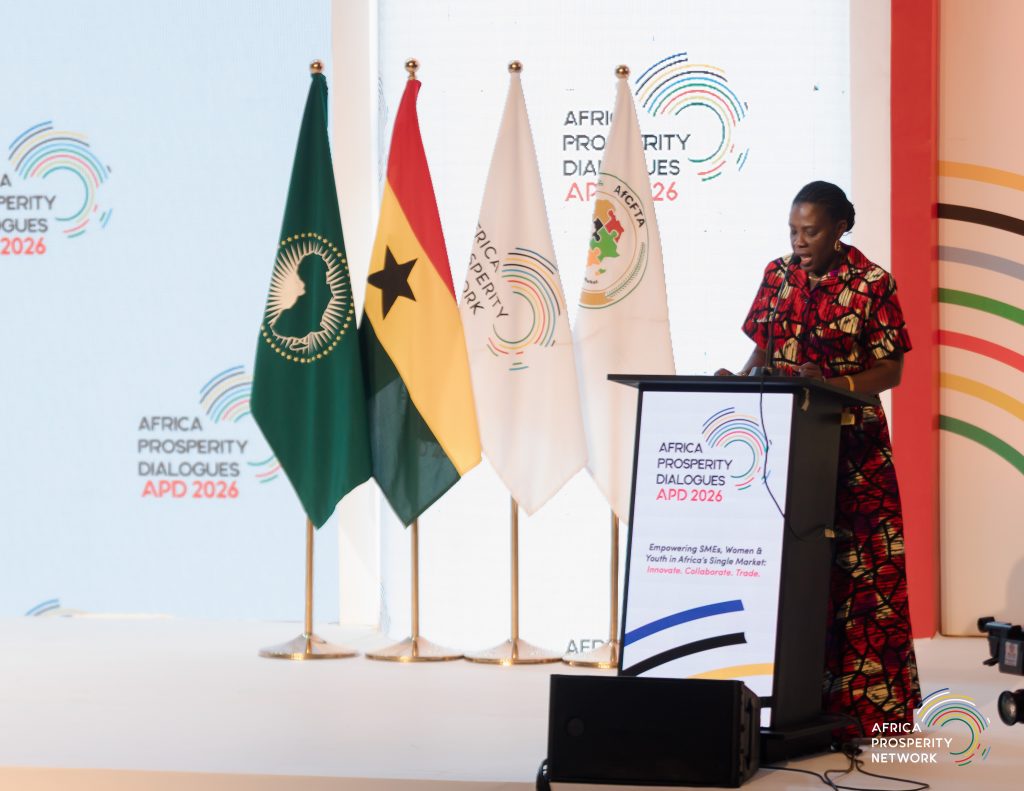
    Africa Prosperity Dialogues has rapidly become one of Africa’s most consequential spaces for shaping our economic future through bold thinking, practical solutions and collective resolve. The Africa Prosperity Network has been exemplary in its visionary leadership in bringing together governments, the private sector, innovators and development partners around a single purpose: to accelerate Africa’s integration and unlock its prosperity. 

    This year’s theme speaks directly to the African Union’s vision of a borderless, opportunity-driven continent. However, Free trade, in the absence of free movement, is an aspiration without substance. Goods cannot move if people cannot move. Opportunity cannot expand if entrepreneurs cannot cross borders. Integration cannot deepen if Africans remain strangers to one another. If we are serious about prosperity, then we must be equally serious about implementing the Protocol on the Free Movement of Persons.

    The call for action on the ratification of the Protocol is apt. We need all 55 Member States to ratify to make Africa truly borderless. As of now, 32 countries have signed, and only 4 have ratified. The minimum we need for the Protocol to come into force is fifteen. So I charge all of us to leave this Dialogue not merely as participants, but as ambassadors for free movement. Because when Africans move, Africa moves forward.

    Africa stands at a defining moment in its economic history. Through AfCFTA, we have created the largest single market in the world by number of countries, with over 1.5 billion people and a combined GDP exceeding 3 trillion USD. But let us remember a simple truth: Markets do not trade, people do. And, economies do not grow from policy frameworks alone; they grow from enterprises.

    If AfCFTA is the engine of Africa’s transformation, then SMEs, women and youth are its power source. Without them, the engine cannot run. Without them, integration cannot deliver prosperity. Across Africa, SMEs represent over 90 per cent of businesses and more than 80 per cent of employment. Yet too many remain local by necessity rather than continental by design. You will all agree with me that an integrated market that excludes SMEs is not integration; it is exclusion.

    We must move African enterprises from survival to scale, from informality to competitiveness and from domestic reach to continental impact. Africa is the youngest continent on earth, and African women are among the most entrepreneurial globally. This is not merely a demographic reality, but it is Africa’s greatest economic advantage. Yet financing gaps persist. Market access remains uneven. Informality continues to suppress growth.

    Empowering women and youth is not a social gesture; it is an economic strategy. When women thrive, economies expand; When youth innovate, productivity rises; When opportunity is shared, stability follows. Africa, therefore, cannot achieve prosperity while half of its potential is underfinanced and its majority underutilised.

    The African Union, working with partners such as the African Development Bank, Afreximbank and the Africa Guarantee Fund, is expanding access to finance and strengthening enterprise ecosystems. But finance alone is not enough. Prosperity requires policy coherence, infrastructure, skills, mobility, and above all, political will.

    Africa’s integration will not be defeated by a lack of ideas, only by a lack of courage to implement them. Critical AU instruments, including the Free Movement Protocol, the Single African Air Transport Market, the Pan-African Payment and Settlement System and the Protocol on Women and Youth in Trade, must now move decisively from agreement to action. The era of signing must give way to the era of delivering.

    Africa’s prosperity will not be imported but built by Africans – Built by our entrepreneurs; Powered by our innovation; and Sustained through our collaboration. History will remember our generation not for the agreements we signed, but for the opportunities we unlocked for Africa’s women, youth and entrepreneurs. If we get this right, Africa will not merely participate in global trade; Africa will help shape it.

    The future of this great continent of ours will not be written solely in Presidential palaces or corporate boardrooms. It will be written by the small business with a big idea, the young innovator bold enough to disrupt the status quo, and the woman entrepreneur transforming her community. This has to be the generation that moved Africa from fragmentation to unity, from potential to productivity, from promise to prosperity. And let history record this final truth: When Africa stood at the crossroads of integration, we did not hesitate – we chose courage, unity, and action.

  • ECOWAS Parliament urged to fast-track AU free movement protocol ratification as integration gaps exposed

    ECOWAS Parliament urged to fast-track AU free movement protocol ratification as integration gaps exposed

    FOR IMMEDIATE RELEASE

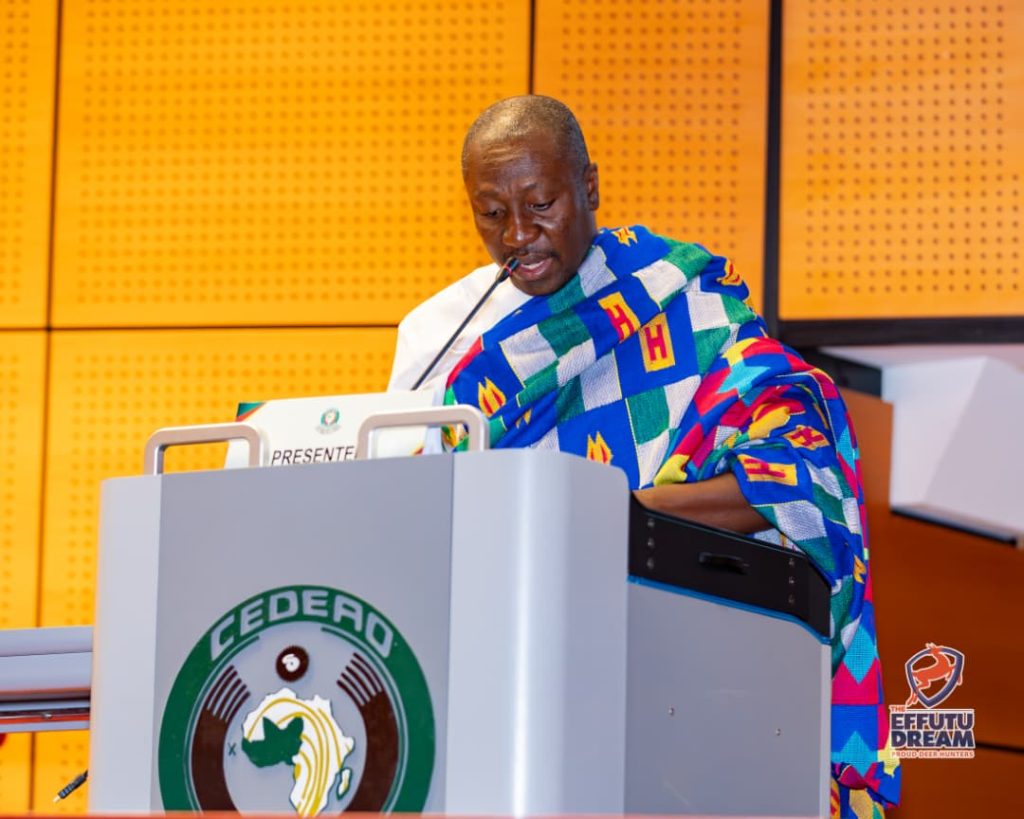
    Abuja, Nigeria, 5 May 2025 — A powerful intervention on the floor of the ECOWAS Parliament has reignited debate over Africa’s stalled integration agenda, with a strong call on West African governments to urgently ratify the African Union’s Protocol on the Free Movement of Persons.

    Delivering a statement of urgent public interest, the Third Deputy Speaker, Hon. Osahen Alex Afenyo Markin warned that without free movement, Africa’s flagship trade initiative, the African Continental Free Trade Area, risks failing to deliver its full promise for the continent’s 1.5 billion people.

    At the heart of the address was a stark contradiction: while African leaders have moved swiftly to liberalise trade, they have failed to match that commitment with the political will to allow Africans themselves to move freely across the continent.

    The AU Free Movement Protocol was adopted by all African Union member states in January 2018, just two months before those same countries signed onto the AfCFTA agreement later that year. Yet, eight years on, progress has been negligible.

    Only four countries, namely, Rwanda, São Tomé and Príncipe, Niger, and Mali, have ratified the protocol, far below the minimum threshold of 15 required for it to enter into force.

    ECOWAS Paradox

    Critically, both Niger and Mali have exited ECOWAS, meaning that technically no ECOWAS member state has ratified the AU protocol, despite the bloc being widely regarded as Africa’s most advanced region on free movement.

    The speech highlighted a paradox at the core of West Africa’s integration story. ECOWAS has long been seen as a leader in facilitating movement across borders, dating back to its 1979 protocol which allows visa-free travel within the region.

    However, the Deputy Speaker argued that this progress remains incomplete and fragile. Citizens still face harassment, extortion, and illegal checkpoints across borders, undermining the very spirit of regional integration.

    More fundamentally, the failure to ratify the AU’s continental protocol means ECOWAS is not legally aligned with Africa’s broader integration architecture.

    The address made a clear and uncompromising point: AfCFTA cannot work without the free movement of people.

    While 49 African countries have ratified AfCFTA, the continued restrictions on movement of persons create a structural contradiction. Goods are expected to move freely, but the traders, entrepreneurs, and workers behind them cannot.

    “We cannot build a true African Continental Free Trade Area if people cannot move with their goods,” the Deputy Speaker stated.

    This disconnect, he warned, risks turning AfCFTA into a partial and underperforming framework rather than the transformative single market envisioned.

    Direct Call to ECOWAS States

    In one of the most pointed sections of the speech, ECOWAS member states were urged to act decisively by completing their domestic ratification processes and depositing instruments with the African Union without delay.

    A formal resolution is being proposed within the ECOWAS Parliament to:

    • Name member states yet to ratify the protocol
    • Demand accelerated legislative action
    • Require regular reporting on progress until full ratification is achieved.

    Regional Leadership Under Scrutiny

    The speech also singled out Ghana, noting the contradiction between its leadership role, hosting the AfCFTA Secretariat and its failure to ratify the free movement protocol.

    While Ghana ranks highly on visa openness and has championed integration discussions, it has yet to complete ratification, with a target set for 2027.

    The Deputy Speaker warned that such delays must not become a comfort zone, stressing that leadership on integration must be matched by legal commitment.

    Mr. Afenyo Markin’s intervention concluded with a broader warning: “Africa’s integration challenge is no longer about vision or policy design, but about implementation.”

    With fewer than two years to key continental milestones under the Abuja Treaty framework, the failure to operationalise free movement risks undermining decades of ambition.

    For ECOWAS, the message was clear, the region must move from being a symbolic leader of free movement to a legal and continental champion of it.

    And, for Africa as a whole, the call was even sharper: without freeing its people, the continent cannot truly free its trade.

    To donate or add your signature to the ten million and support the movement, visit: www.makeafricaborderlessnow.com
    To download the APD 2026 Action Compact, visit: https://africaprosperitynetwork.com/wp-content/uploads/2026/02/APD-Compact-Feb-2026.pdf
    To download the Make Africa Borderless Now! Movement Manifesto, visit: https://africaprosperitynetwork.com/wp-content/uploads/2026/02/4-MAKE-AFRICA-BORDERLESS-NOW-Manifesto-1.pdf

    -ENDS-

    For media inquiries, please contact:
    Prince Moses, Director, Communication Directorate | Africa Prosperity Network| E- mail: princemoses@africaprosperity.network | Accra. Ghana
    Joel Krampa, Communication Lead | Africa Prosperity Network | E-mail: j.krampa@africaproserity.network | Accra. Ghana
    APN Communication Directorate: comms@africaprosperity.network
    Website: www.africaprosperitynetwork.com
    Follow us: Facebook, X(Twitter), LinkedIn, YouTube, WhatsApp, TikTok

    MABN!

    Distributed to all African and International media houses

  • An unwavering support for the Make Africa Borderless Now! Movement

    An unwavering support for the Make Africa Borderless Now! Movement

    by Dr George Elombi, President and Chairman, Board of Directors, African Export-Import Bank (Afreximbank)

    At a moment when Africa is seeking to accelerate growth, deepen resilience, and claim its rightful place in the global economy, we are called to confront one of the most persistent constraints on our collective progress: the barriers—visible and invisible—that continue to fragment our continent. Africa is a continent of extraordinary promise. We are home to the world’s youngest population, vast natural resources, vibrant entrepreneurs, and a shared ambition for prosperity. Yet, despite these advantages, intra-African trade remains far below its potential, and the movement of African people, goods, services, and capital across borders is still far more difficult than it should be.

    Today, it is often easier for an African business to trade with partners outside the continent than with partners from a neighbouring country. It is sometimes easier for a non-African passport holder to move across Africa than for an African citizen. This paradox is not merely an inconvenience; it is a structural constraint on growth, competitiveness, and inclusion.

    The Make Africa Borderless Now! campaign challenges us to rethink what borders mean in the African context. Let me be clear: this campaign is not about erasing sovereignty. It is about re-imagining borders as bridges rather than barriers. A borderless Africa is one where goods move efficiently from farm to factory to market across countries, entrepreneurs scale innovations across regions without prohibitive costs, financial flows support trade rather than constrain it and where Africans can travel, work, and invest across the continent with dignity and ease.

    In short, it is an Africa where integration works in practice—not just on paper. The African Continental Free Trade Area has given us a historic framework. It is the largest free trade area in the world by number of countries, and it embodies the vision of a unified African market. But as we all know, agreements alone do not move trucks across borders, nor do they eliminate delays at ports, checkpoints, and payment systems. Implementation is where ambition meets reality. The Make Africa Borderless Now! campaign is therefore a call to action— a call to translate AfCFTA commitments into measurable outcomes that citizens and businesses can feel.

    Borders matter for business. For African businesses, especially SMEs and women- and youth-led enterprises, border frictions are not abstract policy issues. They are real costs. Delays that spoil perishable goods, documentation requirements that discourage first-time exporters, currency and payment challenges that disrupt supply chains, and regulatory inconsistencies that raise the cost of doing business. 

    When borders are inefficient, African competitiveness suffers, and the promise of regional value chains remains unrealised. At Afreximbank, our mandate is clear: to finance and promote intra- and extra-African trade. But over the years, we have learned that finance alone is not enough. Trade finance must be accompanied by efficient payment systems, harmonised regulations, trade-enabling infrastructure, and strong collaboration between governments and the private sector. This is why Afreximbank has invested not only in capital, but also in systems, platforms, and partnerships that reduce friction across borders.

    A historic opportunity to leapfrog traditional constraints

    Initiatives such as continental payment and settlement solutions, trade facilitation programmes, support for regional value chains, and capacity building for customs, banks, and businesses all share one objective: to make African trade faster, cheaper, and more predictable. The “Make Africa Borderless Now!” campaign speaks directly to this mission.

    History shows us that integration advances fastest when it is championed at the highest political level. The success of this campaign will depend on political will, policy coherence, and accountability in implementation. Presidential leadership sends a powerful signal to public institutions, to the private sector, and to Africa’s development partners – border efficiency is not a technical detail, but a strategic priority.

    Equally important is the role of the private sector. Businesses are not just beneficiaries of a borderless Africa; they are co-architects of it. We must listen to transporters navigating corridors, exporters dealing with compliance requirements, banks managing cross-border risk, and digital innovators simplifying trade processes. Their experience should inform policy, and their innovation should shape solutions.

    Technology offers Africa a historic opportunity to leapfrog traditional constraints. A borderless Africa will be built not only with roads and ports, but also with code, data, and digital trust. Digital customs systems, electronic certificates, interoperable payment platforms, and data-driven risk management can dramatically reduce border delays and costs. But digital transformation requires interoperability across countries, trust between institutions, as well as investment in skills and infrastructure. 

    Integration must be inclusive. If a borderless Africa benefits only large corporations, we will have failed. Women traders, informal cross-border traders, small manufacturers, and young entrepreneurs must experience simpler procedures, lower costs, and greater protection. A truly borderless Africa is one where small traders cross borders safely and legally, youth can scale startups across regions, and women-owned businesses access regional markets on fair terms. This is not just an economic imperative—it is a social one.

    We need boldness to make the “Make Africa Borderless Now!” movement a success, and it is imperative on us to commit to the removal of unnecessary administrative barriers while harmonising standards and procedures, investing in trade-enabling infrastructure, measuring progress transparently and holding ourselves accountable. Let us move from dialogue to delivery, from aspiration to action.

  • Borderless Africa: Dismantling the Financial Integration Challenge

    Borderless Africa: Dismantling the Financial Integration Challenge

    By Babajide Sodipo – Acting Executive Secretary, Alliance of African Multilateral Financial Institutions (AAMFI) – The Africa Club  

    A borderless Africa is not a slogan. It is a strategic necessity. Africa’s Agenda 2063 and the African Continental Free Trade Area are clear in their ambition: an Africa where people, goods, services and crucially, capital can move more freely across borders in support of growth, resilience, and shared prosperity. 

    But we must be honest with ourselves. A truly borderless Africa will not be achieved by policy commitments alone. It is, at its core, a financial integration challenge. Free movement requires African capital to flow efficiently across borders. It requires liquidity, guarantees, risk-sharing instruments, and financial institutions that are able to work together — not in silos, but in coordination.

    This is where African multilateral financial institutions already play a vital role. Across the continent, they finance cross-border trade, regional infrastructure, investment corridors, and payment and settlement systems that make integration real on the ground. When these institutions align and coordinate, their impact is multiplied. That is why AAMFI exists. 

    The Alliance was established to strengthen cooperation among Africa’s multilateral financial institutions and to support continental priorities, including integration, AfCFTA implementation, and the AU Free Movement Protocol — with practical financial solutions.

    AAMFI works closely with the African Union and its institutions to help ensure that Africa’s integration agenda is underpinned by a strong, well-coordinated financial architecture. As the  “Make Africa Borderless Now!” initiative is launched today, AAMFI welcomes the opportunity to lend its collective voice to the importance of free movement, especially the free movement of African capital and to reaffirm our readiness to work with partners to translate Africa’s integration commitments into bankable, scalable outcomes.

    A borderless Africa will be built not only by vision, but by institutions, coordination, and capital. African institutions stand ready to play their part.